

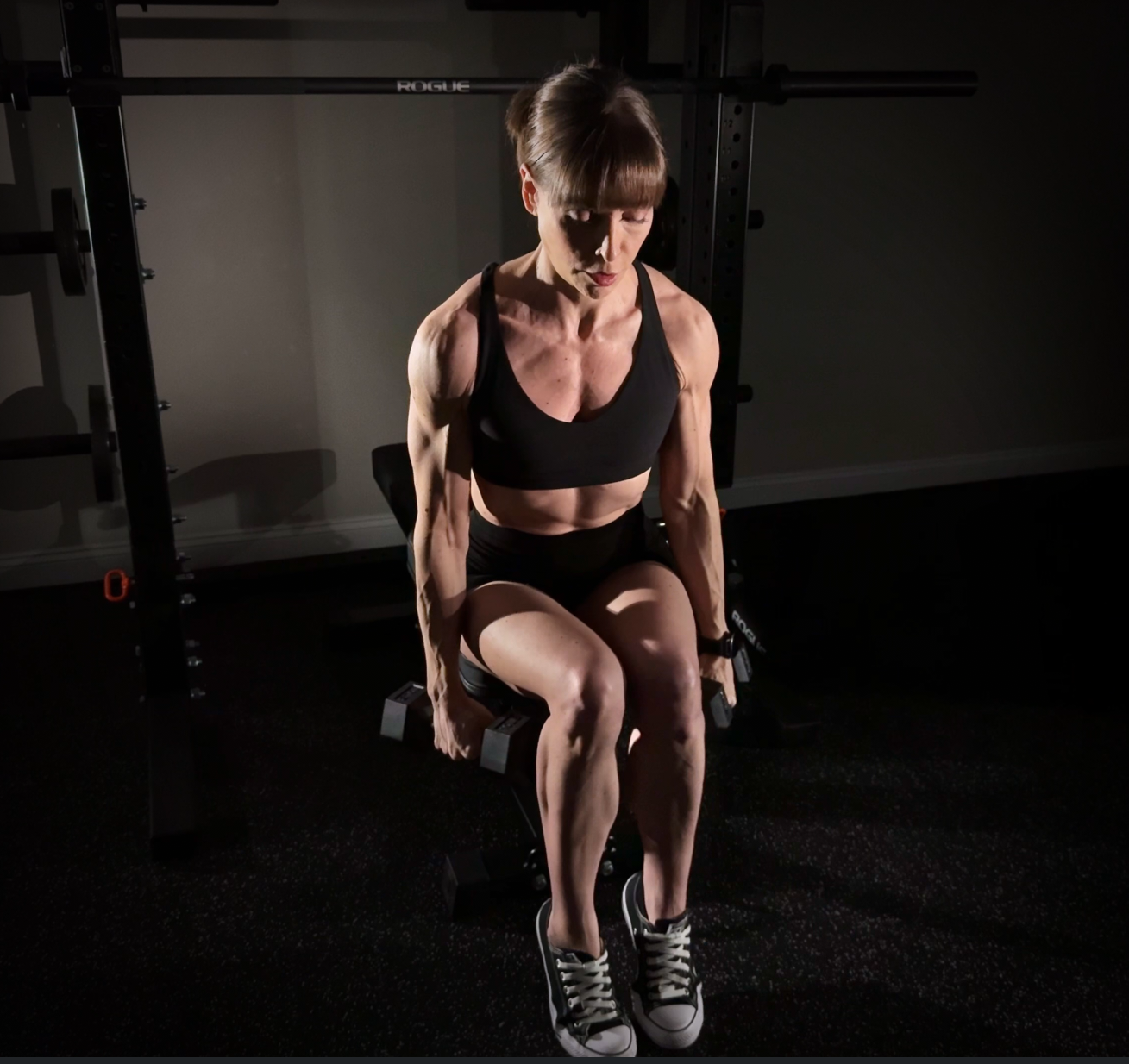
People tend to talk about training technique in one of two equally unhelpful ways. One camp treats form like a rigid checklist: if your joint angles, grip, stance, and scapular position are not exactly right, you are apparently wasting the entire set. The other treats technique as almost irrelevant: effort trumps all, so just move the weight, train hard, and add load whenever possible.
Don’t get me wrong: both camps are right about a lot. I can listen to either side and find myself nodding along. But the extremes of both positions do a poor job of explaining what good technique is actually for.
Before we start, I want to mention that I’m focusing on technique and stimulus in the context of hypertrophy, or building muscle. There are plenty of valid reasons to lift weights, including strength, athletic performance, and so forth. Each goal requires a somewhat different kind of stimulus and therefore asks technique to do a different job. But for our purposes, the goal is bigger muscles.
The point of good technique
Technique is not about making an exercise look pretty, perfectly mimicking what you saw someone do online, or following a purportedly universal checklist of cues. On the flip side, it is also not irrelevant just because you are training hard. Training hard is important, sure, but it does not by itself guarantee results.
For example, when you do lateral raises, the goal is not simply to get the dumbbells from your thighs to shoulder height by whatever means necessary. I mean, you could do that. You’re free to make laterals as hard as you want by using a weight that is too heavy, jerking your torso back as you thrust the dumbbells upward, and elevating your shoulders to hand off some of the load to your traps.
But a set can be hard without being hard for the muscle you meant to train. Sticking with the lateral raise example, if your goal is side delt growth, making the side delt less responsible for moving the weight is not exactly a useful way to make a lateral raise harder. Does a heavier, messier set still train your side delts? Absolutely. Is it automatically a better way to do so? Not necessarily.
The underlying goal of any exercise is to perform it in a way that forces the muscles you want to grow to work hard enough, for long enough, that they have a reason to adapt. Your setup, torso position, range of motion, stability, and how you move the weight all affect how much work the target muscles do, and whether the exercise is challenging for those muscles or merely hard in an abstract way.
Subtle technique adjustments can therefore make a real difference. But not every detail deserves obsessive attention, because some adjustments only make an exercise more elaborate without improving the stimulus we’re trying to create. To understand which adjustments earn their complexity, we first need to dig into why muscles adapt in the first place.
How we create a stimulus for growth
When I use the term stimulus, I am talking about the demand an exercise places on a muscle; in other words, the challenge that gives that muscle a reason to become more capable. But let’s back up for a second and start with why muscles grow.
Muscles grow when they repeatedly encounter demands that are near the upper end of what they are currently capable of meeting. In practice, that means working close enough to a muscle’s current capacity that doing the same work again would be easier if the muscle became bigger and/or stronger.
This does not mean every set needs to end at concentric failure, although failure work can be useful in appropriate contexts. It just means working close enough to failure that the demand registers as a meaningful obstacle, rather than something the muscle already handles without much difficulty.
To put it another way, the body excels at maintaining the status quo. It does not spend energy building bigger, stronger muscles for no reason. Muscle is metabolically expensive tissue, so the body needs a damn good reason to build more of it, or even to keep what it already has. If training repeatedly exposes a muscle to demands near the upper end of what it can manage, and the other conditions for adaptation are met, we’ve given it that reason. If not, the body is basically like, “What? You wanted me to do something?”
How technique changes stimulus
Let’s talk about stimulus using lateral raises as the example. When you are standing with a dumbbell in each hand and your arms at your sides, gravity’s line of pull passes close to the shoulders. The dumbbells therefore create relatively little torque at the shoulder in this position. This is why lifters often say there is no tension at the bottom of a dumbbell lateral raise.
As you raise your arms toward shoulder height, the dumbbells move farther out to the sides of your shoulders. The greater that distance becomes, the more torque gravity creates at the shoulder, and the more the dumbbells try to pull your arms back down. In other words, the external lever arm is getting longer.
To overcome that increasing demand, your side delts must create more tension. That demand is greatest when the dumbbells are around shoulder height, which is why the top part of a standard dumbbell lateral raise usually feels the hardest.
But the external lever arm is only one part of the story. Technique can also change which muscles are best positioned to handle the torque, whether another muscle assists or takes over, and how much momentum you can use.
Here are a few examples specific to lateral raises:
Modifying your torso angle or arm path (for example, leaning forward or raising your arms in the scapular plane) may change the plane of shoulder motion and which fibers or muscles contribute most.
Depressing your shoulders and pushing away rather than up may help keep the upper traps from assisting excessively, if that is an issue you have experienced.
Moving the dumbbells in a wide arc (or at least moving your arms with this intention) can preserve a longer external lever arm, which can make the same weight more demanding for the side delts.
Using chest or back support removes balance, torso lean-back, and momentum as competing limitations. This makes it easier to ensure the side delts, not your ability to stabilize or heave the weight, are what ends the set.
Hopefully this shows why stimulus-focused technique adjustments aren’t just cosmetic; they meaningfully change how much tension a muscle has to produce and whether that muscle is actually the thing that limits the set.
Now, this doesn’t mean every exercise needs to be dissected into inane details. It just means the weight you’re lifting is not the entire story, as the same 15-pound dumbbell can create a very different training stimulus depending on how you perform the exercise.
More weight isn’t always more stimulus
The lateral raise example shows that a light dumbbell can feel heavy depending on how you perform the exercise. The reverse is also true: using a heavier dumbbell does not automatically mean you’ve created more stimulus for the muscle you intended to train.
It certainly can mean that, of course. If you can use more load while keeping the tension on the muscle(s) you want to grow, maintaining the intended range of motion for the exercise, and you can stay in a rep range that makes sense for that movement, then a heavier dumbbell is probably a better stimulus.
Sometimes, however, all you did was change the exercise for the worse. If increasing the load forced you to shorten the range of motion, shift the work to another muscle, add momentum, or change your body position in a way that reduced the demand on the muscle you’re trying to grow, congratulations: you probably just lost some of the stimulus you were trying to increase.
Strict does not mean rigid
I’ve talked a lot about the importance of using a technique that preserves the stimulus you’re going for. But that doesn’t mean you must be uber strict all the time. The goal isn’t to lift like a robot who never deviates from technical perfection. It’s to choose an execution that ensures you’re training what you want to train, and that you can repeat honestly enough to know whether you are improving it.
The fun part is that good technique and controlled cheating are not mutually exclusive. Assuming an exercise is a good candidate for cheat reps or partials, it’s actually fine to cheat on the concentric for a rep or two to extend a set after you’ve reached technical failure. (This is when you can no longer perform another rep with whatever technique you chose.)
Doing this can squeeze a little more work out of an otherwise exhausted muscle. The difference between productive and non-productive cheating is intent and timing. For example, using a little body English after a set of honest lateral raises or curls is very different from heaving the weight from rep one because it’s too heavy for the number of reps you meant to do.
Here’s the difference. When you finish a set with cheat reps or partials, you’re deliberately changing technique to extend a hard set that had already provided a strong stimulus. On the other hand, when you cheat for the entire set, you might just get a worse stimulus with the consolation prize of getting to log a bigger number. But what good is a bigger number if it didn’t produce a better result?
Stability generally enhances stimulus
Now that we’ve established that deliberately changing technique near the end of a hard set is different from allowing every rep to drift wherever it wants from the start, let’s talk about one of the most useful tools for keeping an exercise focused on a muscle: stability.
Stability is a loaded term because it can mean different things depending on who you ask and how they train. For some, it means planks and side planks. For others, it’s choosing bilateral lifts like barbell squats instead of a less stable variation like pistol squats.
For our purposes, though, I’m talking about external stability, which means using your setup or equipment to limit the creative and interesting ways your body can (and will) figure out to finish a rep once the muscle you’re training runs out of steam.
Think your body won’t do that? Think again. If there’s one thing our bodies are good at, it’s subtly altering movement to make a workload easier to manage as the prime movers fatigue. This is largely unconscious, so you may not even notice when it’s happening. Part of maturing as a lifter is learning to notice when it happens and self-correct during a set, but that takes time.
Meanwhile, what if you haven’t yet developed the body awareness or mind-muscle connection to feel when stimulus is drifting? Or if you’re plenty experienced, but want to veto your body’s ability to drift up front? That’s where stability comes in.
Exercises that provide external stability don’t force you to rely entirely on self-monitoring. They basically function like guardrails around your body that communicate, “Move here, in this way. No, not there. Here. There you go.” They make the compensations your body is most likely to use less achievable in the first place.
This might mean going chest-down on an incline bench or posting your upper back and glutes against a wall or upright, so you can’t lean your torso back or thrust your hips to generate momentum. It might mean choosing a chest press machine rather than a barbell bench press, which reduces how much effort your body spends stabilizing the load and staying in the right position.
Here are some general examples of adding stability to a lift:
Using a machine instead of a barbell or dumbbells, including Smith, plate-loaded, and selectorized machines.
Using an incline bench, wall, or upright to stabilize your chest or back.
Choosing a variation with support built in, such as a chest-supported T-bar row instead of a bent-over T-bar row.
Another huge consideration is that stable exercises can often be pushed closer to local muscular failure. With an appropriate machine or stable setup, you usually don’t need to keep the same reps in reserve you do with, say, a barbell bench press or squat. Since you aren’t worried about balancing, bracing, losing position, or escaping a failed rep, you can often just go until the muscle can’t.
You don’t need to go crazy with this, though. Plenty of unstable exercises are valuable and can still have a home in your programming if you enjoy doing them. But if two exercises train the same muscle and you don’t strongly prefer either, the more stable option probably has a slight edge for muscle growth. It just gives you fewer ways to turn the exercise into something else.
Technique is not copy-and-paste
Alright, so technique and stability are valuable in preserving stimulus. Now to add a wrinkle: stable does not automatically mean better in all cases. For example, there is no single correct lateral-raise setup, nor is there one that is automatically right for everyone.
Different people have different proportions, mobility, preferences, training histories, and ways of compensating when a set gets hard. A cue that helps one person keep their side delts loaded may feel awkward, irritating, or even counterproductive for someone else. To put it another way, a cue should solve a problem that exists for a person, not create a new problem for them or just confuse them.
This is why you shouldn’t think about technique in terms of whether you’re adhering to some universally optimal standard for how to do an exercise. Instead, think about whether an adjustment genuinely improves an exercise. Does it make your technique more consistent? Does it make it easier to progress? Does it keep tension where you want it? If so, keep the cue. If not, don’t sweat it.
Don’t feel pressured to change your technique simply because someone online posted a video or short about a new cue. Keep that cue in your back pocket, sure. Try it if you struggle with stimulus drift on a specific lift or it just doesn’t feel right. But you don’t have to fix what isn’t broken. If you like experimenting, awesome. (I do too.) Still, consider whether your adjustments solve a problem.
How progressive overload fits into all this
Before we get into progress, we need to talk about progressive overload. People often translate that concept into a rule that you must add weight or reps whenever possible, as though a bigger number itself is what leads to hypertrophy. But a bigger log number and the biological stimulus for muscle growth are not necessarily the same thing.
Hypertrophy is a complex process involving several mechanisms. Mechanical tension, which is the force muscle fibers have to produce while working against resistance, is widely considered the primary one. This recent review of load-induced hypertrophy is a good deeper dive if you want to learn more about muscle growth mechanisms.
Alright, so since we need mechanical tension to grow, it’s natural to assume that adding weight is therefore the most important part of lifting. That is why we log our workouts, right? So we can increase weight over time? Yes and no.
A training log can reflect whether your capacity is changing over time. What it can’t do is create the adaptation for you. We adapt because hard sets create a stimulus, but the training log only records it. Think of stimulus as spending and the log as accounting.
For your training log to tell you anything even remotely useful, it needs to compare the same exercise from one session to the next. Remember how we talked about how technique drift can change an exercise into something else? This is where that starts to matter. Your technique should be consistent enough to reasonably ensure that you’re comparing apples-to-apples in your log.
When overload doesn’t mean progress
Let’s say you’re doing a lateral raise, since we apparently love lateral raises around here. You’ve been using 15-pound dumbbells for a while now, and you got 15, 13, 11 reps last week. This week, you want to add a rep to any of the sets if possible. If you can add a rep without changing your technique, sweet.
But let’s say that the only way you can get that extra rep is by throwing your torso back or elevating your shoulders so your traps can help out. Is that progress? I mean, you did make the log number bigger, so something happened. But what was that something, and did you actually progress the original version of the lateral raise you had been doing?
Well, you may have matched your reps on the original version with the technique that works for you (like depressed shoulders, flat ribs, and eccentric control). Then you added a rep by changing your technique enough that your traps plus momentum carried you to the finish line. So again, is that progress of the original exercise? Not really.
That’s why adding reps or weight every workout has enormous potential to miss the point. Should you take another rep when you have the honest capacity to do so? Unquestionably. Stop sandbagging if that’s what you’re doing. Just remember that a bigger number does not automatically mean you progressed the exercise you intended to train.
Maybe you repeat the same weight and reps for several weeks, but your final rep looks cleaner every time. Maybe you gradually need to use less momentum, have greater control or range of motion, or just feel like the set doesn’t take quite as much out of you. Those are all signs that the same demand is becoming easier. That’s progress.
What progress really means
Remember that the added rep is not what makes a muscle grow. The stimulus is, which is what your hard sets are doing already. Each session deposits pennies in the hypertrophy bank and, over time, pennies add up. Eventually, you have enough additional capacity (whether from a larger muscle or increased skill and coordination) to get another honest rep or to add weight.
Bigger numbers reveal progress, but they don’t create it out of thin air. Adding weight and reps matter and are a part of the process. Just don’t confuse correlation with causation. You can’t force more reps or load into existence by wanting them badly enough. When the next rep is there, take it. If it is not, continue punching the stimulus clock and wait for your body to be ready.
