

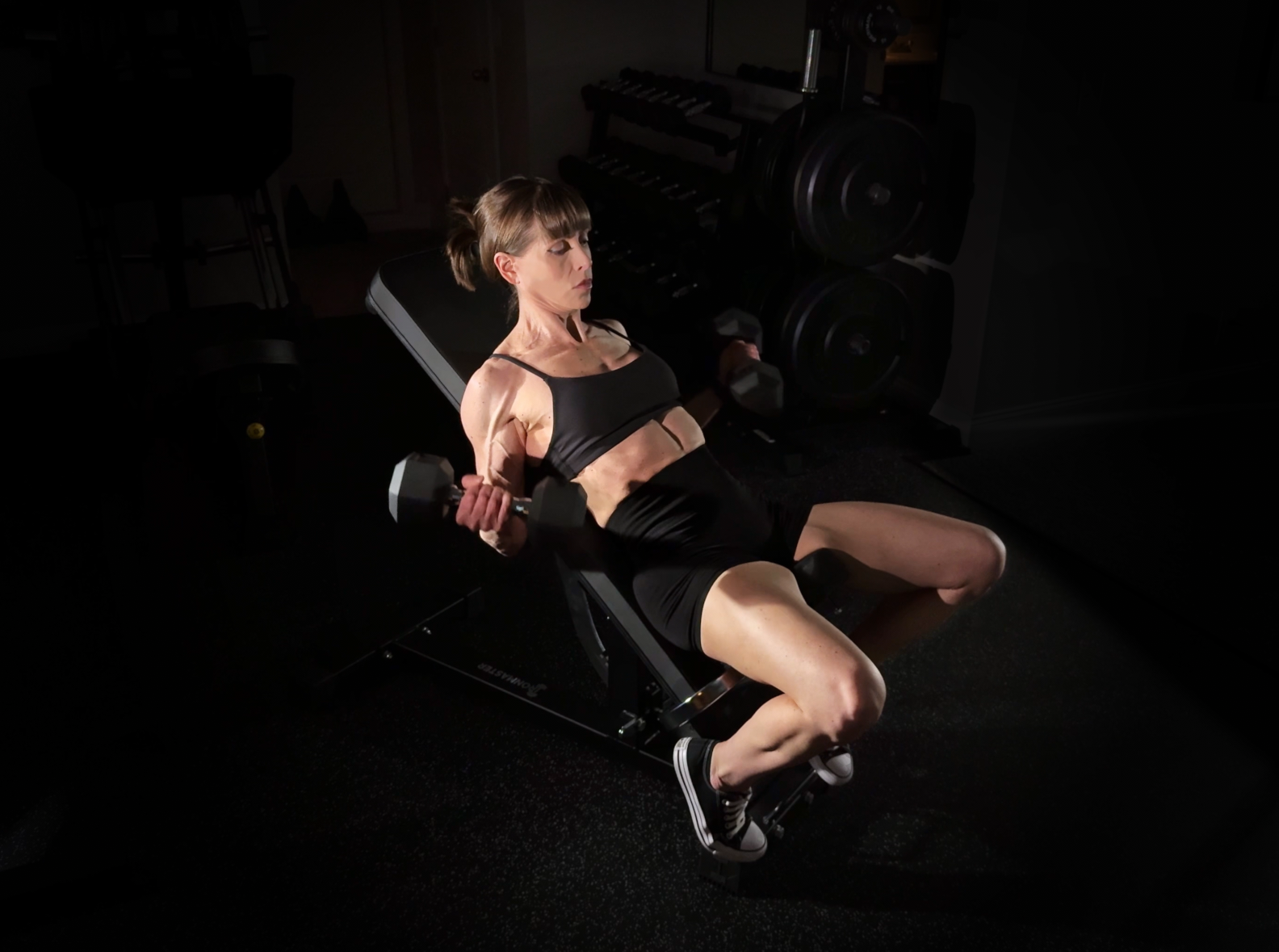
What do you think about when you train? Is it sets, reps, and load? Pushing to get that last rep? Maybe your form? Or do you think about Newton’s Second Law of Motion, the relationship between net force and acceleration, and the torque required to produce angular acceleration around your joints? Probably not the last one, huh?
But I have a super-exciting thing to tell you (or at least it’s exciting to me): physics governs everything you do in the gym. See, human movement involves rotation around joints. The forces acting on your body and the distances at which they act from those joints influence how much effort your muscles have to produce. That’s physics, baby.
It also involves your body proportions. The lengths of your limbs and torso affect the positions you can get into and the leverage involved in an exercise. Together, these things help explain why an exercise feels different as you move through a rep, why a change in position alters the demand of the same weight, and why the same lift may look different from one person to another.
The physics behind weightlifting
We’ll start with levers, and then we’ll go over torque. A lever is a simple machine consisting of a rigid beam that rotates around a pivot point. Seesaws, scissors, wheelbarrows, nutcrackers, and tweezers are all levers. Levers have three main components:
Fulcrum: the pivot point or axis of rotation
Effort: the force used to move or hold the lever
Load: the resistance being moved or held
In our bodies, bones act as levers with joints serving as pivot points. Muscles produce force on those bones. Gravity and other forms of resistance, like body weight and free weights, create demands that the muscles must work against or control.
But force alone doesn't tell you how much a joint has to work. A 50-pound dumbbell creates a very different demand at your elbow depending on where your hand is relative to the joint. Torque quantifies that demand by telling us how strongly a force tends to rotate an object around an axis. We can calculate the torque produced by a force using the following formula:
Torque = Force × Moment Arm
The force might be the pull of gravity on a dumbbell or barbell. The moment arm, also called a lever arm, is the perpendicular distance from the axis of rotation (which in this case is the working joint or joints) to the force’s line of action.
Here’s what that looks like in practice. Imagine you’re doing a standing dumbbell biceps curl. Gravity pulls a dumbbell downward, so its line of action is vertical. To find the dumbbell’s moment arm at your elbow, you’d draw a vertical line through the weight at different points of a rep, then measure the horizontal distance from your elbow to that line.
If this sounds like gibberish so far, don’t worry. We’ll get into some visual examples later on that will hopefully make it clear. Until then, the key takeaway is that torque changes throughout a rep and, for the same force, a longer moment arm produces more torque, whereas a shorter moment arm produces less.
Practical applications in strength training
Levers are classified by where the fulcrum, effort, and load sit in relation to one another. Here are some examples:
In first-class levers, like a triceps pushdown, the fulcrum is between the effort and the load. Mechanical examples include seesaws, scissors, pliers, crowbars, and light switches.
In second-class levers, like a calf raise, the load is between the fulcrum and the effort. Mechanical examples include wheelbarrows, bottle openers, nutcrackers, staplers, nailclippers, and doors on hinges.
In third-class levers, like a biceps curl, the effort is between the fulcrum and the load. Mechanical examples include brooms, fishing rods, tweezers, kitchen tongs, and baseball bats.
The lever class is just a point of interest, not something you need to memorize. I just wanted to pair each body example with mechanical examples in case it helps. Now let’s dig into what really matters: how moment arms change during a rep and whether that change is due to the normal mechanics of a rep, technique preferences, or a form mistake.
Levers and biceps curls
The biceps curl is an excellent example of how moment arm changes during a rep because it’s a relatively straightforward movement. In lever speak, here are the components:
The fulcrum is your elbow joint.
The effort is performed by your elbow flexors, including the biceps.
The load is the dumbbell in your hand.
Think of the bottom position of a standing dumbbell curl, where your upper arms are vertical. In this position, your hand is directly below your elbow, meaning the dumbbell’s moment arm at the elbow is quite short.
As you curl, the horizontal distance between your elbow and the dumbbell’s vertical line of action increases. This means that for the first half of a rep, every inch you raise the dumbbell makes it feel heavier. The horizontal distance peaks when your forearm is roughly horizontal, which is when the dumbbell creates its greatest external torque at the elbow.
Once you’re beyond the halfway point, the distance shortens again, so it starts feeling easier. If you continue curling until the dumbbell touches your shoulder, it probably feels almost as light up there as it does when your hand is hanging below your shoulder. That’s because the moment arm is at its shortest in both positions; therefore, these feel easy while the middle part feels hard.
Levers and squats
The squat is more complex than a biceps curl because movement occurs at three joints: the hips, knees, and ankles. And just to add a nice little wrinkle into the mix, your torso angle and the position of the barbell on your back impact the demand at each joint.
Knee-dominant squats, like high-bar and front squats, are performed with a relatively upright torso and significant forward knee travel. To keep the bar moving roughly vertically over your midfoot with an upright torso, your knees travel farther forward while your hips stay closer to the line of force. This lengthens the knee moment arm while shortening the hip moment arm.
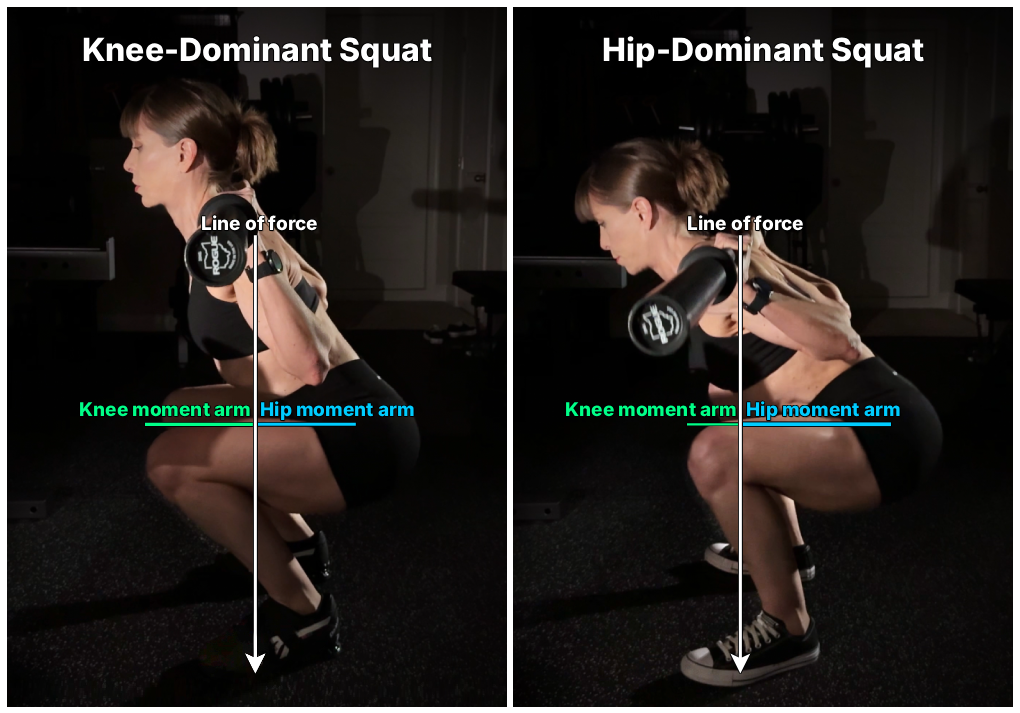
Hip-dominant squats, like low-bar squats, are performed with a more forward-leaning torso and less forward knee travel. To keep the bar moving roughly vertically over your midfoot with a forward-leaning torso, your knees stay closer to the line of force while your hips travel farther back. This shortens the knee moment arm while lengthening the hip moment arm.
This doesn’t mean that high-bar squats don’t train your glutes or that low-bar squats don’t train your quads. In fact, studies like this one have found no significant difference in muscle activation between the two. Changing the moment arms shifts the demand at each joint, but the squat is a complex movement involving muscles that cross both the hip and knee and help distribute force between them.
Levers and deadlifts
The deadlift involves both hip and knee extension, along with the work required to maintain your torso position and hold the bar. Positioning, body proportions, and the bar’s path all affect the demands of the lift.
When the bar drifts farther forward, its horizontal distance from the hips increases. In turn, this increases the turning effect of the bar’s weight about the hips and increases the demand on the muscles involved in maintaining position and extending the hips. Your spinal erectors are part of the system that maintains your position.
While it’s often said that deadlifts should be performed with your legs, not your back, your lower back is actually supposed to work during a deadlift. Your spinal erectors isometrically contract to resist torque while your glutes and hamstrings perform hip extension. Given their involvement, it’s normal to feel your erectors doing something during a deadlift.
We just don’t want the bar to drift forward, as this increases the horizontal distance between the load and your hips and lower back, creating more torque at both. What does that mean? Basically, it means that it’s harder for your hip extensors to move the load and for your spinal erectors to maintain your torso position.
It’s already a hard lift, so don’t make it harder than it needs to be. A good deadlift setup puts the bar close enough that you can lift it without having to pull it around your legs or let it drift unnecessarily forward. This involves where your shoulders, hips, and armpits sit relative to the bar, but the details are a topic for another article.
Your proportions affect the levers
We all have differently sized bones. Some of us have short legs or arms, a long torso, and so forth. Inside the larger body segments, like your limbs, are smaller segments that can be different lengths, too. For example, maybe we both have equal-length arms, but my humeri (upper arm bones) are longer than yours; therefore, my radius and ulna (forearm bones) are shorter than yours.
These proportions affect how hard certain exercises feel and the positions we can get into. Once again, a biceps curl is an easy example since it’s just one lever. Longer forearm bones create a longer moment arm, which increases the external torque at the elbow. Put simply, all else being equal, a 20-pound curl feels harder to someone with long forearm bones than someone with shorter ones.
It gets really fun when multiple levers are involved. In multi-joint (compound) exercises like squats and deadlifts, your particular combination of bone lengths governs the positions you can use to produce force while also not falling over. (Always remember that not falling over is priority number one.) In turn, these positions affect how torque is distributed across your joints.
Picture two lifters squatting. One squats with considerable forward lean and comes out of the hole hips-first. The other squats perfectly upright, every joint flexing and extending in unison, looking elegant and effortless. Which lifter is squatting correctly? They both are; they’re just built differently.
In a squat, the relative lengths of your torso, femurs, and lower legs, along with your ankle mobility, affect how far your knees travel and how upright you can keep your torso. These positions change the moment arms and torque at your hips and knees.
In a deadlift, someone with longer arms can usually reach the bar with a more upright torso, while someone with shorter arms might need to lean forward more. Someone may also prefer to pull conventional or sumo due to their proportions.
This is why good technique for big barbell lifts won’t look identical between lifters. For single-joint exercises like curls, however, differences in proportions mainly affect load. They usually don’t fundamentally change how you should perform the exercise.
Manipulating the lever arm to change difficulty
Many exercises can be progressed by lengthening the lever arm, regressed by shortening the lever arm, or simply altered in a way that lets you use a different load. Take lateral raises, for example. You can do them with bent, semi-bent, or straight arms. While they’re all the same exercise, the lever arm manipulation makes each version feel quite different. Here’s what I mean:
With your elbows bent, the dumbbells sit closer to your shoulders, shortening the horizontal distance between the shoulder joint and the dumbbell's vertical line of action. This makes the same weight feel easier.
With your arms straight, the dumbbells sit farther from your shoulders, lengthening their external moment arms and increasing the torque produced by the weight. This makes the same weight feel harder.
Lever arm manipulation is the main tool for progressing and regressing bodyweight exercises. You can’t just add or remove bodyweight like you can add or strip plates from a bar, but you can alter moment arms to change demand. For example, you can make a hanging leg raise easier by bending your knees or a plank harder by moving your elbows forward.
Lever arm manipulation is also useful in standard resistance training because it can allow you to get more out of a light weight. It might also let you use a weight that would otherwise be a little too heavy, which is especially helpful if the dumbbells you want are being used by someone else, or you need an in-between weight that isn’t available.
What I hope you take away from this
While I find levers and torque interesting, you honestly don’t have to know anything about torque to build muscle or get stronger. If you loved reading this and want to experiment with it, awesome. If it was boring or confusing, no worries.
The key takeaway with all this isn’t to know everything about torque. It’s just to think, “Okay, so it’s normal if my technique looks different from someone else’s and it has an explanation.” Or maybe, “So that’s why I keep hearing to keep the bar against my legs on deadlifts.” That’s it. You don’t need to understand the why unless you’re interested, just that certain adjustments may help or hurt.
A little experiment for anyone interested
If you want to experiment, try this the next time you do a biceps curl. As you perform the concentric (lifting) part of the rep, what happens in the middle when your forearms are horizontal? Do you lean into the difficulty and drive the lever through the point where the moment arm is longest? Or do you lean back, swing, and bring your shoulders into it to heave the weight past that point?
If it’s the latter, I’m side-eyeing you right now. Imagine you put a load in a wheelbarrow, then just picked up the entire wheelbarrow and carried it. The wheel is still there, but you’re not using it to do the job you brought it for. That wouldn’t be the smartest move. Similarly, if you have to swing a curl past the hardest part, well now you’ve used momentum to yank the weight through a range of motion in which the lever was supposed to be doing the work. You’ve also missed the point of the exercise entirely.
The point isn’t just to move the weight from point A to B. It’s to make the intended muscles work against it.
